"EACH DISCOVERY REVEALS A NEW DIMENSION TO YOUR LEGACY"

THE UNFOLDING JOURNEY is a new blog written in association with Legacy Genealogy.

This blog is a blend of disciplines that reveal the rich texture of culture and history that surrounded your ancestors' lives, as well as your own. We will take you beyond just the names, dates, and places to give you the "back story" for the reasons your ancestors thought what they thought and did what they did. We invite you to also visit us at the Legacy Genealogy facebook page at http://facebook.com/legacygenealogy

Sunday, September 8, 2013

THE ART OF THE DEAL
On May 24, 1626, 387 years ago, the newly arrived leader of the Dutch colony of New Netherland, Peter Minuit, arranged to trade goods valued at 60 guilders to the Lenape Indians for the acquisition of the island of Manhattan (in present day New York). This act has been heralded down through history as a prime example of how Europeans took advantage of Native Americans, but was it really?
  
The exchange was first acknowledged six months later in a letter written by Peter Schaghen, a member of the board of the Dutch West India Company, the organization that employed Minuit and funded the Dutch colony. He reported that a deal was made with the local Indians to purchase 11,000 morgens (about 22,000 acres) of land on the island of “manhattes” for a value of sixty guilders. He did not specify if it was in coin or bartered goods. His report of the acquisition was only two sentences in length. Most of his letter was a list of furs and grains that were brought back from New Netherland.

Two hundred years later, the value of 60 guilders, in 1626, was determined to be about $24 in U.S. money. That number has stuck ever since in story and song. Today, those 60 guilders is estimated at $1,000 U.S. The myth of the trade was enhanced in the late 19th century to be a payment in bead, trinkets, and buttons. It is really quite irrelevant since the value of Manhattan is many times either amount; and the value paid to the Lenape people was not considered by either side as the primary purpose of the transaction.

Many historians believe that the Lenape lived on Long Island (actually today’s Brooklyn) and not Manhattan at all. Manhattan Island at the time was an unsettled hunting ground that was used by several tribes, and was simply a route used to move from the mainland to Long Island. Like most Native American tribes, the idea of “owning” any natural environment was ridiculous. The land, the trees, and the water were given to them by the spirits to support life; it could not be the property of any man or tribe. The right to use these things belonged to all. The European concept of ownership was quite different. Yet neither party returned home feeling that they had been deceived.

Why then, was the apparent barter of artifacts for land consummated? The basic theory is that both sides received far more than what was reported in Peter Schaghen’s letter. The Lenape received two intangible advantages. First, they received from the Dutch technology which was more advanced than what they had. This probably took the form of metal axes, hoes, shovels, and iron cooking ware that made their lives easier and more productive. Second, they formed a military alliance with the Europeans that strengthened their defensive position with competing tribes.

The Dutch received the assurance of expanded trade with the native peoples, which was the purpose of their future little settlement of New Amsterdam at the tip of Manhattan anyway. They were fur traders and access to hunting and trapping grounds, not to mention barter with the Indians for furs, was the primary reason the Dutch West India Company was even there. It was a win-win proposition for both parties - “the art of the deal.” The $24 in trinkets and beads could be considered just a finder’s fee.


So, how did this deal work out in the long run? The Lenape are gone. The Dutch are gone. Manhattan is part of the United States. In 2006, the estimated value of property on Manhattan Island was $802.4 billion. That equates to $2.08 billion for every year since 1626; $56.9 million for every day or $2.37 million every hour (for all 3,381,360 hours since Peter Minuit made the trade). Donald Trump would be envious.

Tuesday, September 3, 2013

OPPORTUNITY ONLY DANCES WITH THOSE WHO ACTUALLY TAKE TO THE DANCE FLOOR
Dance is art; dance is culture. American dance styles of the late 20th Century reflected the times in which we were living. There was a mixing of cultures on the dance floor, in the clubs, and even in the aisles of movie theaters. Today, we are taking a look at just a few of the dances that most of us at least attempted to perform . . . once upon a time.

SOLO DANCES (Partners are optional; showmanship is rewarded)
THE LIMBO (1956) - From Trinidad; you bend backwards and walk underneath a bar without touching it. Yes, it is considered a dance. (Inspiration: The film “Where the Boys Are.”)

BREAK DANCING (1980) - Created in NYC, break dancing is a collection of rhythmic moves that are largely improvisational. It was in response to early rap music.

THE RUNNING MAN (1982) - Basically running in place. The dancer slide steps with the feet rapidly moving back and forth while swinging the arms. (Inspiration: M C Hammer)
THE ROBOT (1983) - A dance that imitates the movement of a robot; it isolates different parts of the body that freeze or lock, then reactivate.
PARTNER DANCES (The customary dances; but some may take courage)
THE MASHED POTATO (1962) - Similar to the Twist; dancers move their feet in and out, and back and forth. (Inspiration: Dee Dee Sharpe’s “Mashed Potato Time” and James Brown’s “Do the Mashed Potato”).

THE FRUG, pronounced “Froog” (1964) - Dancers make lateral movements rather than moving their hips. Basically the Twist with more arm movement, and while standing still. This style was a precursor to the Monkey and the Swim.

THE JERK (1966) - It was similar to the Monkey, but with finger snapping.

THE BUMP (1972) - Just what it sounds like; bumping hips to the beat of the music.
THE LAMBADA (1989) - a.k.a. The Forbidden Dance, it’s a fast and sensual Brazilian dance. (Inspiration: the film “The Lambada”)
GROUP DANCES AND LINE DANCES (Great after a few drinks)
BUNNY HOP (1952) - Created in San Francisco; you stand in a line holding the hips of the person in front of you and hop forward and backward.

THE HULLY GULLY (1964) - A line dance where an MC calls out various dance moves while the music speeds up. (Inspiration: The Groups the Olympics and The Marathons)

THE HUSTLE (1971) - Either a line dance or a partner dance; it’s based on the mambo and originated in the Hispanic NYC. It involves walking side to side and back and forth (mass exposure through the film “Saturday Night Fever”)
THRILLER DANCE (1984) - Pop culture’s biggest group dance number still being performed today. It was also one of the first grand music videos. (Inspiration: Michael Jackson’s “Thriller” video)

ANIMAL DANCES (Duplicating animal motions; named appropriately)
THE PONY (1961) - Dancers hop from side to side in a galloping motion. (Inspiration: Chubby Checkers’ “Pony Time”)

THE CHICKEN / THE FUNKY CHICKEN (about 1960) - A variation of the Twist; dancers put their hands on their hips and swing their arms back and forth like, well, chickens.
THE MONKEY (1963) - Dancers move their arms up and down in front of their bodies rapidly while twisting their hips. (Inspiration: Major Lance’s “Monkey Time” and the Miracles’ “Mickey’s Monkey”)
FREE-FORM DANCES (Dances with few steps; they allow a lot of creativity)
THE TWIST (1960) - Within a year of the song’s recording, all generations were doing it. Dancers twist from side to side; feet may or may not move their feet. (Inspiration: Chubby Checkers, who got his name from Dick Clark).

THE SWIM (1961) - With limited movement of the legs, dancers’ arms imitate swimming strokes. (Inspiration: Bobby Freeman’s “C’mon and Swim”)

THE WATUSI (1967) - Ultimately you can do whatever twisting and turning you want to do. (Inspiration: The Orlons’ “The Wah-Watusi”)

DISCO (1970’s) - Disco includes both music and dance. Dancers move to a thumping beat and dance closer to each other than styles of the 1960’s. Synthesized music is common. The “hustle” and “bump” are off shoots of disco.

VOGUE (1993) - This is a throwback to the 1930’s. “Voguing” is a dance style incorporating model-like poses and using rigid body movements. (Inspiration: Madonna’s “Vogue” video)

FAD DANCES (numerous, short-lived, but ever present)
THE FREDDIE (1964) - Standing in place, lift your left leg and left arm together, then alternate to the right side. (Inspiration: Freddie and the Dreamers’ “I’m Telling You Now”)

THE TIME WARP (1975) - A parody of earlier styles, it became an accepted dance on its own. Frequent audience participation. (Inspiration: the film “Rocky Horror Picture Show”)
WALK LIKE AN EGYPTIAN (1986) - A fad dance where dancers pose similar to the poses on ancient Egyptian reliefs. (Inspiration: The song by the Bangles and Steve Martin comedy routines)
DANCES FOR PEOPLE WHO CAN’T DANCE
(Dances for the rest of us)
Y.M.C.A. (1979) - It’s a dance where you put your hands in the air and form the letters y, m, c, and a along with the chorus of the song “Y.M.C.A.” by the Village People. No need to use your feet. Strong on audience participation.

THE MACARENA (1996) - This is a “dance” where all the action is done with the arms. An old flamenco melody. (Inspiration: the 1995 Bayside Boys’ song “Macarena”)


How many of these dances do you remember? Can you tell us about some others? How many did you do? 

Friday, August 30, 2013

The Civil War History of the 57th Indiana (#23)
June 27, 1864.
Sherman’s Army stands facing Kennesaw Mountain, northwest of the City of Atlanta . . .
“Newton’s division was the one assigned by Gen. Howard (Corps Commander) to make the assault in front of the 4th Corps, and at the point designated was in front of Stanley’s division. At 7 o’clock A.M. our brigade formed and marched over to the rear of the line where the attack was to be made. Gen. Wagner (Brigade Commander) gave Col. Blanch (Regiment Commander) his choice of position; either to join in the column or deploy his regiment as skirmishers and move up in front of the column. Col. Blanch chose the latter, and at once deployed the regiment five paces apart, preparatory to an advance.
“The 40th Indiana occupied the front of the assaulting column. At 8 o’clock A.M. the signal was given to advance. Our regiment crossed the works, and drove the rebel skirmishers into their fortifications. The enemy reserved their artillery fire till the 40th advanced to within a short distance of their works, had raised the yell, and were moving forward on the double-quick, when they opened a withering fire of grape and canister, which carried death and destruction in its pathway. The assaulting party was checked and the men laid down.
“Other regiments were now thrown forward, and the assault was several times renewed, but all in vain. The order was given to fall back by companies from the rear, but in the confusion and excitement it was misunderstood, and a general retreat commenced. The slaughter among our troops at this moment was even greater than when they advanced, for the enemy now rose from behind their works, fearless of danger from the retreating force, and fired with greater precision than when the column advanced.
 In one hour the engagement was over, and our brigade again returned to their former position, behind the line of works. The 57th lost twenty-two in this bloody and almost fruitless engagement. The assault, though it secured no immediate victory, was evidence to the enemy that we could assault as well as flank, and thus prevent them from weakening their lines to extend their flanks.
“On the 28th, the regiment was again on the skirmish line In many places, when there was quiet along the lines, the men on each side would expose themselves to view, and even exchanged papers, traded coffee for tobacco, and bartered in various ways. This, however, was soon brought to a close by an order from Gen. Sherman; prohibiting all communication with the enemy.
“On the night of the 28th, Col. Blanch, by request, held a consultation between the lines with the colonel of the 5th Arkansas, rebel regiment, who offered to let us remove the dead of our regiment still remaining on neutral ground. But Gen. Howard believed it was only done to throw us off our guard, in order that they could make a night attack, and nothing was done.
“The resolution which Gen. Sherman had formed, of driving the enemy across the Chattahoochie River, was not changed by the failure of this assault; and on the night of July 2nd he commenced to lengthen his lines. When the day dawned, no rebel flag floated from the crest of Kennesaw, for Johnston, preferring to expose the front rather than leave his rear unprotected, had abandoned his position and moved toward the river. Pursuit was commenced immediately. The 4th Corps, marching to Marietta, moved from there down the railroad. The enemy made a temporary halt behind a line of works near the Smyrna campground, about five miles south of Marietta. Our line of battle was formed, and we remained in position all day during the 4th. An occasional artillery duel or sharp picket firing was all that transpired on the lines, and at night the enemy withdrew.
“We reached Vining’s Station, at the crossing of the Chattahoochie, a little past noon, and went into camp east of the railroad. From a hill near camp we could plainly see the steeples of Atlanta, twelve miles distant. Between us and the city was the smoke of rebel camps and heavy clouds of dirt disclosed the position of troops in motion along the road.
“On the 9th of July, Gen. Sherman commenced moving his army across the river. At daylight a force of cavalry crossed at Roswell, a small town sixteen miles east of Vining’s Station, and held a position south of the river, until the arrival of our division which marched up from camp and forded just after dark. We threw up entrenchments, and remained in position until the 11th, when we were relieved by the 16th Corps. On the 13th the division crossed on a bridge of canvas pontoons, and joined the corps, which was then in line on a commanding ridge, three miles from the river. On the 18th, at 5 o’clock A.M., we moved from our fortified camp and took the road leading to Atlanta.
“On the next day the enemy was driven across Peachtree Creek by Wood’s division, which crossed at night and threw up a line of works on the south bank of the stream. In the morning they were relieved by our division. Skirmishing was constantly going on between our front line and the enemy, who were posted behind a strong line of rifle pits, on higher ground at the edge of the timber. Artillery was brought forward and commenced shelling them. Their position soon became unpleasant from the fire of our guns, and at 2 o’clock they fell back toward Atlanta.
“Notwithstanding the masterly skill displayed by confederate Gen. Johnston during the eventful campaign which followed the movement of our army from Chattanooga, the rebel authorities at Richmond were not satisfied with his declaration that he could not hold Atlanta with the army under his command; and they at once appointed Gen. John Bell Hood to succeed him.
“We are now about to record the commencement of a series of daring and reckless attempts, made by a true representative of hot-blooded “southern chivalry,” to stay the irresistible progress of a large and victorious army. The engagement at Peach Tree Creek would be the turning point for the overthrow and destruction of the rebel army in Georgia. By his wild infatuation, amounting to madness, southern blood would flow like water, and the sacrifice of human lives was a consideration far beneath Hood. The disastrous results of his unmitigated cruelty will stand out in bold relief among the prominent events of our late war, as proof of what a ‘piece of work’ of a man could do.” 

(Atlanta Campaign, northern Georgia, June -July, 1864)

Excerpts taken from “Annals of the Fifty-Seventh Regiment, Indiana Volunteer Infantry: Marches, Battles, and Incidents of Army Life” written by Asbury L. Kerwood immediately after the war.

Monday, August 26, 2013

THE LAST 24 HOURS OF THE ALAMO

The Battle of the Alamo ended on March 6, 1836. It has become a legendary event in the history of Texas, and all of the country.

During the early 1830’s, many immigrants from the U.S. had settled along the Mexican border in an area known as Texas. They made few attempts to adopt the Mexican culture. But what they did do was to inspire the native locals, called Texicans, to oppose the iron-handed rule of President Antonio Lopez de Santa Anna. He, in turn, blamed the unrest on the unwanted American immigrants (which it was). The upsurge in opposition to the government reached a climax in October 1835 when groups of Texicans drove the last Mexican soldiers out of the region.

The angered Santa Anna perceived the Americans to be the source of the problem, and began to prepare an army to deal with them. He announced that, if caught, all foreigners fighting in Texas were not to be taken as prisoners but were to be executed immediately.

One large group of Texicans and their American allies converged on the village of San Antonio de Bexar just before the end of the year. They converted the small three-acre Alamo Mission into an improvised fort. Its walls, where walls existed at all, were 9’ to 12’ high but the perimeter of the fort was 1,320’ around the outside; a distance that the 100 volunteers inside would not be able to defend. The defenders had 19 cannons that were left behind when government troops evacuated the area. Repeated requests were made to the rebel Texican government for more men, ammunition, and other supplies; but none were available. Other small groups of volunteers did arrive during late December; most notably Col. James Bowie with 30 men, Col. William Travis with 30 more, and Davy Crockett with a band of Tennessee sharpshooters. 

By late December, Santa Anna would wait no longer and led his army of over 6,000 soldiers northward toward San Antonio de Bexar (modern San Antonio). He was not without problems of his own. When pay was delayed for the civilian teamsters, they quit. Supply shortages were made worse by the need to feed the many women and children who followed the army. The biggest problem, however, was that most of his soldiers were untrained. They had to be taught how to march in formation, as well as aim and shoot their weapons
.
By February 21, 1836, the Mexican Army was within 25 miles of the Alamo. Two days later, it had reached and surrounded the mission, staying at a distance of about 300 yards. The Texicans inside asked Santa Anna for an honorable surrender, but he refused and repeated that all foreigners would be instantly executed. He believed that there was no glory in a bloodless victory.
For the next twelve days, the Mexican Army waited in siege outside the Alamo. There were several small skirmishes but the casualties on both sides were slight (9 Mexicans, 1 Texican). The Alamo defenders sent scouts out to search for the rescue parties that they were promised were coming. But there was no rescue.

THE LAST DAY
On March 5th, General Santa Anna told his officers that the assault would commence the next morning. At 10:00 p.m., the Mexican artillery ceased firing, and 2,000 troops prepared to move on the Alamo in the first assault. Another five hundred cavalry encircled the fort to pick off any defenders who would try to escape the slaughter.

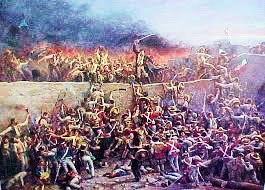
At 5:30 am, with heavy clouds blocking the sunrise, and the Texican pickets located outside the walls killed, four columns of infantry approached within range of the Alamo. Most of the defenders were still sleeping when the first volleys came in. The Mexican buglers sounded the charge. The Texicans and the Americans ran to their posts. Having little ammunition for their cannons, the men loaded the barrels with metal scraps, nails, and horseshoes.

The Mexican infantry columns were now pressed tightly up against the walls of the fort. The Texicans who leaned over the edge to fire down on the enemy left themselves exposed to musket fire from soldiers farther out. The American Commander, William Travis, was one of the first to die. Few of the dozens of ladders carried by the Mexicans reached the walls of the Alamo, and soldiers that were able to raise and climb them were quickly killed. The defenders almost immediately ran out of the muskets that had been loaded in advance, and they struggled to reload. After a brief time, the first wave of Santa Anna’s troops fell back.

In their next assault, Mexican infantry under Gen. Amador found a small gate in the north wall that was open and poured into the Alamo plaza. The defenders’ artillery turned around from their position on the south wall and fired on the enemy streaming in. Within a few minutes, however, other Mexican soldiers reached the top of the wall where the artillery was now facing away from them and killed all the Texican gunners.

As the battle raged, most of the defenders fell back to the mission’s buildings, abandoning the walls. A few dozen men on the west wall were cut off from the main body and headed out of the Alamo toward the river to escape. They were spotted by the Mexican cavalry who charged and killed all of them. A similar event took place on the opposite side of the Alamo when a small group tried to escape only to be massacred by cavalry.

Davy Crockett and his men were the last defender’s still remaining without cover from enemy volleys. They used their muskets as clubs because they couldn’t reload them. But they were no match for the Mexican infantry’s bayonets. In spite of rumors that Crockett was captured, a Mexican eyewitness confirmed that he had been killed and was surrounded by sixteen Mexican corpses. With the remaining defenders now hold up in the church and the barrack building, the Mexican artillery turned their guns on the doors and fired. This was followed by a musket volley and a bayonet charge into the buildings. Jim Bowie, who was sick in one of the rooms, tried to fight from his bed but was stabbed to death. As the fury of combat subsided, Mexican soldiers examined each body, bayoneting anyone that moved. By 6:30 am, the battle was over. None of the Texican fighters survived. A few historians claim that a Henry Warnell escaped the battle but there is no conclusive proof.


In all, between 182 and 240 Texicans died. Their bodies were stacked and burned. The ashes were left undisturbed for almost a year afterward. Only a few women and children were left alive. They were given blankets and a few pesos and returned to their homes in Bexar. One woman, Susanna Dickinson, and her two children were spared so that they could tell the story of Santa Anna’s vengeance to other American intruders. General Santa Anna believed that the story would convince the Americans to leave Texas, but it prompted the opposite result.


One month later, the Texican Army under Sam Houston defeated Santa Anna at the Battle of San Jacinto in less than 18 minutes, spurred on by the cry “Remember the Alamo.”

Wednesday, August 21, 2013

“I LOVE THE NAME OF HONOR, 
MORE THAN I FEAR DEATH”
(Julius Caesar)
When I was a boy studying Latin, I read Caesar’s “Commentaries on the Gallic War,” which was traditionally assigned to students as their first authentically written text. We all struggled through the first book (there were eight) as we were just fledglings trying to translate the words of the great Julius Caesar. But as we became more proficient, his simple yet elegant words took all of us back in time 2,000 years. During his campaigns in Gaul, Caesar would sit in his tent at night writing about the amazing things he had seen and done.

Everyone familiar with western civilization has some point of reference for Julius Caesar. Yet few of us really know him as a man. He was a scholar, priest, lawyer, general, and leader - but he was also a son, husband, and father. Here is a side of him that you may not know.

He was born Gaius Julius Caesar in 100 BCE. His father and grandfather had the same name but were referred to as “the elder” and “the younger.” The family claimed that they were descendants of a legendary Trojan prince who was the son of the goddess Venus. Legend says that they adopted name “Caesar” because a distant ancestor was born by caesarean section, but this is an unlikely assumption. The explanation that is most plausible is that the word “caesai” is the source. It means “one who has killed an elephant.” Young Julius liked this and when he came to power years later, he had coins issued featuring elephants.

The Caesar family was a member of the Roman privileged class but they were not outstanding in either wealth or power, and lived modestly. In 85 BCE, Caesar’s father died unexpectedly leaving the 16 year old Julius as the head of the family. At 17 he was selected to become a high priest of Jupiter, which seemed to point the way to his future career.

Julius was married three times. His first wife, Cornelia, died giving birth to their daughter Julia, his only legitimate child. He was married to Pompeia for only six years when it ended in divorce with no children. His third wife, Calpunia Pisonis, was with him until his death, again without children. Caesar also had two illegitimate children. Cleopatra gave him a son called Caesarion who was named Pharaoh of Egypt but died before adulthood. Another son was born as result of a youthful affair with Servilla Caepionis. That boy was named Marcus Brutus, more about him later. His favorite, however, was the boy he adopted. His name was Octavianus and he was actually Caesar’s great nephew by blood.
  
When Julius was about twenty, the dictator Lucius Sulla began purging Rome of all his political enemies which included the Caesar family. The young man was stripped of his inheritance and his priesthood, and was forced into hiding. He left Rome and joined the army. The loss of his priesthood permitted him to follow a military career for which he was well suited. He was tall for the times, with a fair complexion. He was strong and an excellent horseman. Julius was found to be a brave soldier, and received several medals for his conduct.

After hearing that Sulla was now dead, Julius returned to Rome. Because his inheritance had been seized, he was forced to live in a lower-class neighborhood. Then a new career beckoned. He turned to law. He gained recognition as an exceptional lawyer. His brilliant oratory style and dramatic gesturing was made even more striking by his deep set, piercing black eyes and patrician features. He was elected as a tribune. His wife of 14 years, Cornelia Cinnilla, who he married when he was just seventeen, died in 69 BCE. After her funeral, Julius Caesar, now 31, returned to the military life.

A crossroads in his life was reached while serving in Spain. He visited a statue of Alexander the Great. Caesar realized to his dismay that Alexander had conquered most of the known world by the same age that he was then. He recognized that he had achieved so little in his life to that point, and dedicated himself to being the great man that he would eventually become. Through talent and ambition, Julius Caesar subdued the Spanish tribes and was appointed the Governor of Spain. He was a tireless commander in the field, often walking at the head of his troops instead of riding near the rear. If they were stopped by swollen rivers, Caesar himself would be the first to enter the water and swim across. With the complete loyalty of his legions and the wealth of Spain on his side, he decided to reach for control of Rome itself. 
   
The rest of the story, as they say, is well known. He led his army through Gaul, Belgae, and Britain, and fought a series of civil wars. In 50 BCE, Julius Caesar, now 50 years old, was ordered by the Senate to disband his army and return to Rome to be tried for insubordination. He returned alright, but with his army. His enemies fled but he pardoned almost all of them. Julius Caesar was appointed dictator of Rome. For the next few years he reigned without opposition. He established a new constitution and brought order back to the empire.

Even though he was now an old man, considering the human life span at the time, he remained in good health except for bouts of fainting. Today, historians and physicians have attempted to diagnose what Caesar suffered from. Many believe it was epilepsy but others think it was malaria, hypoglycemia, or severe migraine headaches. Whatever it was, it plagued him during his later years. He kept good care of his appearance. His broad face was always clean shaven and his hair trimmed. Caesar wore a laurel wreath crown almost every day, as he is often depicted in illustrations. It wasn’t because he was being superior, but because he was mostly bald and extremely self conscious about it. The wreath hid his receding hair line.

On the Ides of March in 44 BCE, an opposing political faction assassinated Julius Caesar on the steps of the Senate. He was stabbed 23 times. He attempted to get away but he was blinded by blood, tripped, and fell. His body laid on the steps for three hours. His last words are remembered as “Et tu, Brute?” (You too Brutus?), but those are Shakespeare’s words. His actual words were “You too, child?” which is more prophetic as the final blow came from Marcus Brutus, who Caesar, and many historians, believed was his own illegitimate son.


After Caesar’s death, power flowed to his adopted son, Octavianus, who later took the name Caesar Augustus. Augustus became the first Emperor of Rome after defeating Mark Antony in a bloody civil war. It is appropriate that our months of July (named for Julius Caesar) and August (named form Caesar Augustus) lie next to each other.

Friday, August 16, 2013


STOP BY THE WHITE HOUSE
FOR A PIECE OF CHEESE

Presidential Inaugurations are a very big deal. The larger audiences seem to accompany Democrats, Bill Clinton’s attracted 800,000 (1993). Until 2009 the largest crowd to witness an inauguration was for Lyndon Johnson at 1.2 million. That record was broken by Barack Obama’s ceremony that drew 1.8 million.  George Bush’s ceremony (2005) drew a paltry 400,000.

In 1829, our seventh and newest president, Andrew Jackson, left Nashville, Tennessee, for the three week trip to Washington and his inauguration. Large crowds greeted him at every stop. He was the first “frontier” president and a favorite among the common citizen. On March 4th, a crowd of 20,000 assembled outside the East Portico of the Capitol to view Andrew Jackson taking the oath of office for his first term. This was a very large crowd for the time.


They were excited but remained well behaved for the most part. The ceremony began about 10:00 am. Jackson bowed to the crowd to thunderous cheering then began reading his address. The crowd remained silent so as to hear him. At the conclusion of the speech, the Chief Justice administered the oath (this order is reversed today). The people pushed forward over the barriers to get a closer look. The new President had planned to exit from the opposite side of the building but he had one more thing to say to the crowd. 

Now today after an inauguration ceremony finishes, most people just go on home and the cleanup crews begin their work. Only a select few are invited to attend the reception. But President Andrew Jackson had received a large 1,400 lb cheese from an admirer in New York and he, being a man of the people, invited all 20,000 ceremony attendees over to the White House for a meet and greet, and to have a bite of the cheese. . . and they all came.

Jackson rode a white horse from the Capitol to the White House followed by most of the 20,000 on foot or in wagons. Many were poor, wearing homemadeclothes and shoddy shoes. The crowd included men, women, and children; white and black; farmers and merchants.

The crowd was so large that the President’s guards could not keep it out of the White House proper. People forced their way into the building in search of food and drink, and to shake Old Hickory’s hand. The crowd pushed themselves through all the rooms. Many who got in could not now get out and were followed by still others looking for the President to congratulate him. When they found him, Jackson was pushed up and pinned against the wall by well-wishers. Those in the back stood on the furniture in muddy shoes to get a look at him. Thousands of dollars in glasses and china were broken by the crush of the crowd. The cheese lasted only for a few hours with many bits of it ground into the carpet. 

The mass of people descended into a largely drunken mob; fighting broke out. Ladies fainted. The White House staff carried buckets of punch and whiskey out onto the front lawn in an effort to lure the visitors out. Jackson himself had to flee the situation through a side door and spent the night at a nearby hotel. After some period of time, things began to settle down.

Andrew Jackson, the “People’s President,” thinking that he had made a simple kind gesture to the assembled citizens, unintentionally brought on a riot. No good deed goes unpunished, however, and Jackson received a new nickname - “King Mob.”

Sunday, August 11, 2013


“COME DOWN FROM THE MOUNTAINS”

When World War II commenced in the Pacific between the Japanese and the British and Americans, the Imperial Japanese Army was held in great contempt. Their army had been struggling for ten years to conquer the Chinese, and victory there was still a long way off. Since they had experienced so much trouble with the Chinese, they would be no match for the Allies. One British general remarked, “Don’t you think our men are worthy of some better enemy that the Japanese?”

But as actual combat began, the Japanese proved more than capable. They quickly took possession of Singapore and Hong Kong. They were brave and tenacious. Their image among the Allies changed from one of disdain to one of respect as the intensity increased. The American strategy of island hopping was met at every turn by Japanese troops who would not give up regardless of the odds. Many Japanese defenders fought to the very last man.

Finally, in August of 1945, the war ended. It was a blessed relief for all sides. Emperor Hirohito urged his countrymen “to endure the unendurable and bear the unbearable.” He never explicitly used the terms “surrender” or “defeat” but simply said that the “war did not turn in Japan’s favor.” But not all Japanese soldiers laid down their arms. Tens of thousands remained in China; some fighting for the Communists and some for the Nationalists. Other smaller groups continued fighting on Guadalcanal, Peleliu, and in the Philippines through 1948.  

Here are the stories of the last three Japanese soldiers to be found after World War II ended. All were holdouts.

SHOICHI YOKAI was an apprentice tailor when he was drafted into the army in 1941. After several assignments, he arrived on Guam in 1943. The following year, the island was captured by the Americans. Corporal Yokai and ten other soldiers went into hiding to avoid imprisonment. Eventually the group broke up and seven of the men moved away. The remaining three decided to separate also but to stay in the same general locality. They visited each other up until 1964 when two died during a flood. Shoichi Yokai was left to fend for himself. For the next eight years he lived alone in a cave. Occasionally Yokai found Allied leaflets announcing that the war was over, but he refused to believe them and considered it propaganda. He hunted at night for food and during daylight he made clothes out of native plants. 

On January 24, 1972, two local Guamanian men found Yokai fishing along the banks of the Talofofo River. He still had his government issued Imperial Army rifle, but he had stopped fighting years earlier. Believing his life to be in danger, he attacked the two men. They subdued him and took him to the authorities. When questioned by the local police, Yokai admitted knowing that the war probably over at least twenty years earlier but he was too frightened to give himself up.

He was repatriated to Japan and upon arriving said, “It is with much embarrassment, but I have returned.” He received his back pay totaling $300 and a small pension. Shoichi Yokai died in 1997. He was buried under a cemetery headstone that his mother purchased in 1955 - the year that he was originally declared dead.

TERUO NAKAMURA was born in the Japanese colony of Taiwan. He was drafted into the Imperial Army in November of 1943 and was stationed on the Indonesian island of Morotai. When the Allies liberated Morotai in September 1944, Teruo was listed as missing (which he was) and then declared dead in 1945 (which he wasn’t). He lived with a group of other Japanese holdouts until the 1950’s. In 1956 he broke away from the group to live on his own. He constructed a small hut and cultivated a plot of land large enough to feed himself.

His hut was discovered by accident by a pilot flying overhead in 1974. The Japanese government requested help from Indonesia in searching for Nakamura. Spotted again from the air, local soldiers apprehended him on December 18th. At the time of his capture, he spoke no Japanese or Chinese. He did not want to be taken back to Japan but instead asked to be returned to Taiwan, the place of his birth. Concerned over questions about the colonial control over Taiwan years earlier, the Japanese government agreed to allow him to be repatriated in Taiwan. He received a sum of $227.59 for his military service of 31 years. Teruo Nakamura died two years later. He was the last known WWII Japanese holdout.

HIROO ONODA enlisted in the Imperial Japanese Army in 1942 and was trained as an intelligence officer and commando. In late 1944, he was assigned to Lubang Island in the Philippines. His orders were to hamper the enemy attacks on the island by destroying airstrips and harbor piers. Onoda’s orders also read that he was, under no circumstances, allowed to surrender or take his own life. Onoda is pictured below as a young intelligence officer (left) and after he surrendered decades later (right).

Allied forces landed on Lubang Island in February 1945 and quickly overpowered the Japanese defenders. Only Onoda and three others remained alive. He refused to lay down his arms. As a soldier, he knew it was his duty to obey orders but without any orders to the contrary, he was to keep on fighting. What singled Onoda out was that he actually did continue the fight.

The four men took to the island’s hills. To survive in the jungle, Onoda and his men had to be constantly on the move. They lived off the land and occasionally shot a local farmer’s cow for meat. Under Onoda’s command, the little team carried out guerrilla warfare. They engaged in the destruction of supplies, had several shootouts with the police, and killed about 30 Filipinos in the process. They saw the leaflets dropped proclaiming that the war was over which read, “The war ended on August 15. Come down from the mountains.” He concluded that these were just Allied propaganda. Later some leaflets were actually printed with surrender orders from the Japanese high command. Onoda decided that they were not genuine. Attempts to flush them out failed. Humanitarian missions were sent to Lubang to convince them that the war was in fact over and to appeal to them to surrender. Even today Onoda insists that they believed the missions were enemy tricks designed to lower their guard.

In 1950, one of his men, Private Yuichi Akatsu, surrendered to Philippine authorities. Two years later, letters and family pictures were dropped from aircraft urging the remaining three men to surrender. Again they thought it was a trick. In 1954, Corporal Shoichi Shimada was killed by gunfire by a search party looking for the guerrilla team. Eighteen years later in 1972, Private Kinshichi Kozuka was killed by shots fired by local police. Now Onoda was alone.

On February 20, 1974, a travelling Japanese college student, Norio Suzuki, found Onoda by accident. Suzuki asked if the officer would accompany him back to the authorities. He still refused to surrender and said that he was waiting for orders from a superior officer. Suzuki returned to Japan with proof of his meeting with Onoda. Amazingly, the government located Onoda’s WWII commanding officer, Major Yoshimi Taniguchi, and flew him to Lubang Island. On March 9, 1974, the Major personally gave the Lieutenant the order that he was relieved of his duty. Hiroo Onoda had never surrendered. He turned over his sword, his rifle (still in working order), 500 rounds of ammunition, and several hand grenades; and he went home.

Onoda became an author. He also opened an educational camp for young people teaching traditional Japanese values. He even found time to raise cattle in Brazil several months each year. Onoda also donated money to build a school on Lubang Island. He got married in 1976, and is doing just fine at age 90.